CHAI Lab · Human–AI interaction research
What makes a voice worth talking to?
Designing a voice assistant people could talk to, and an experiment we could learn from.
MSc Artificial Intelligence, Utrecht University · With Northeastern’s CHAI Lab and Calico.care · 2026
Download my thesis (PDF · 11.6 MB)
Research at Northeastern's CHAI Lab, for my master's at Utrecht University, with support from Calico.care.




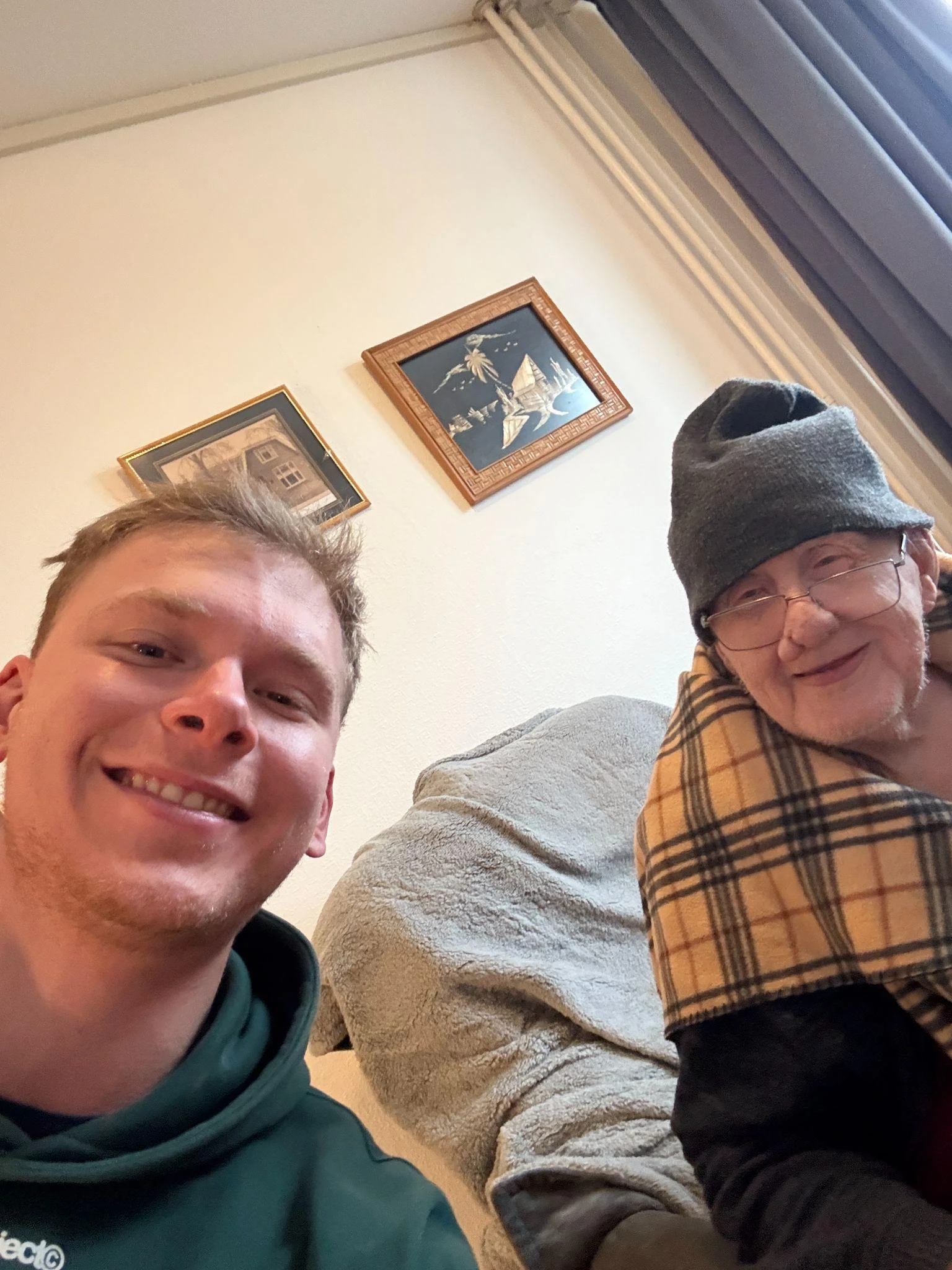
For my grandfather,
voice was a way in.
After my grandfather became blind, he used voice assistants for everyday things: checking the time, hearing the news and weather, and calling friends and family.
Over time, he also asked for stories and conversation. He was looking for a little company, but the technology struggled to offer the interaction he wanted.
Seeing that up close made the potential of voice AI personal to me. It could make everyday life more accessible. The quality of the conversation mattered, too.
How should a voice assistant ask how you’re feeling?
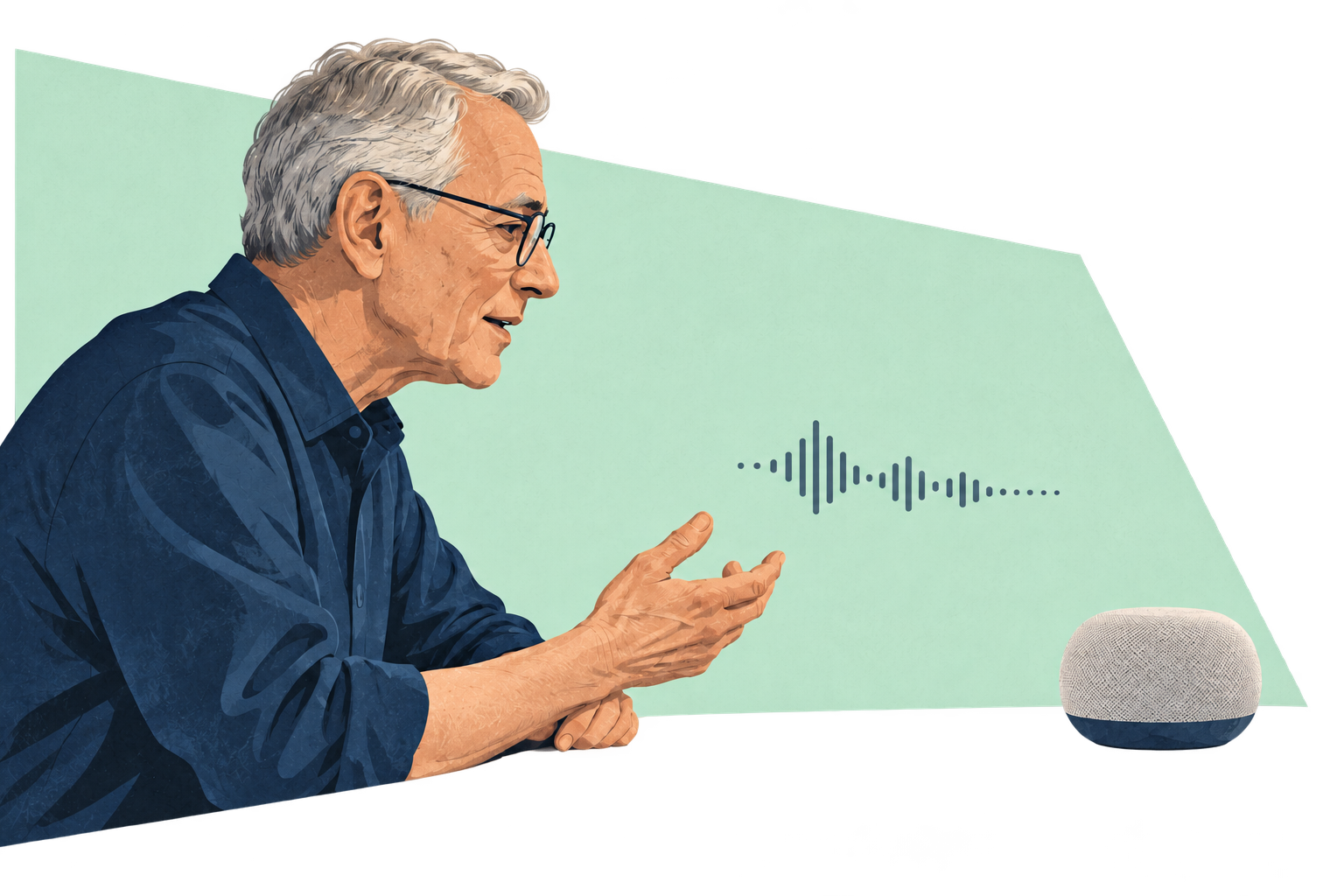
When you do feel even a small amount of hope,
what tends to support it, whether a person, a routine, or a belief?
My kids, we get together, we try and make a point of getting together every week.
You know, I like hearing about what they're doing at school or my daughter's job hunt.
Being engaged with my kids is an emotional lift.
I was already interested in voice as a new medium for design. With the research team, I built a voice assistant to study whether a formal or informal conversational style changes how older adults experience a well-being check-in.
CHAI Lab at Northeastern brings together design, human–computer interaction, and AI research. The lab explores how conversational AI can adapt to individual needs, support human decision-making, and help in emotionally complex situations while respecting people’s agency.
What I wanted to find out
Would the voice assistant's conversational style change how older adults rated its empathy, likeability, intelligence, human likeness, or trust? Would it change their intention to use it, or how much they said during the check-in?
I expected the informal style to feel more empathetic and encourage longer responses. I expected the formal style to feel more trustworthy. Either style could have made people more willing to use the voice assistant.

Formal
Hello, my name is Cali. This session involves a brief well-being check-in consisting of several questions regarding your recent emotional state. If any part of what I say is unclear, or if repetition or clarification is required, please indicate this.

Informal
Hey there, I'm Cali. I'll be doing a quick well-being check-in with you today and asking a few questions about how you've been feeling lately. If anything I say is unclear or if you want me to repeat something, just let me know.
Two conversational styles, one voice assistant. The portraits illustrate tone, not study participants.
The study needed consistency. The conversation needed room to breathe.
Research needed consistency. The language model kept improvising. Early versions skipped questions, asked too many follow-ups, and went down rabbit holes instead of moving on.
I couldn’t make every conversation identical without losing what made it a conversation. Instead, I worked on keeping the structure consistent while allowing the responses to vary.
I iterated on structured prompts, added examples of the conversations I wanted, and lowered the temperature to reduce variability. The final design kept five core questions in the same order, with a reflective acknowledgment and one follow-up after each.
- PracticeCheck the audio and try speaking to the voice assistant.
- Five core questionsAsk → listen → reflect → one follow-up.
Then move to the next question. - SummarizeCheck the summary, invite anything else, and close.
The goal became a stable structure and a perceptible difference between styles. I checked the latter through participants’ ratings and analysis of the voice assistant’s language.
A simple study still had places to get stuck.
Participants were dropping out before completing the study. I had tested the experience myself and with friends and family, but that hadn’t revealed everything. I needed to understand where real participants were getting stuck.
I added tracking to see where people clicked and how long they spent on each page. I also messaged participants on Prolific and got on a call with one of them. Together, those observations pointed to microphone setup as a source of friction.
I added a practice conversation so people could check their microphone and speakers before the main check-in, and refined the surrounding instructions and interface. Pre-pilot and pilot testing helped me make further adjustments before the main study.
The lesson wasn’t just to test the assistant. It was to watch how people reached it, and talk to the people who couldn’t.
People heard the difference. It did not change the main outcomes.
In the final sample of 137 older adults, participants recognized the voice assistant’s formal and informal styles. But the styles did not lead to reliable differences in empathy, trust, likeability, perceived intelligence, human likeness, intention to use, or how participants spoke during the check-in.
At first, I was frustrated and confused. I’d put so much into making the comparison work. But a result that challenges an expectation is useful too. This study gave me a reason to question how much weight to put on formality alone in a brief well-being check-in.
It also taught me to keep the conclusion specific. This was a single-session study comparing two conversational styles. The result doesn’t establish that style never matters.
What this made me curious about
This study broadened my interest beyond how people rate an AI. I’m also interested in how the interaction shapes what they choose to talk about, how personal the conversation becomes, and what helps them feel comfortable opening up.
My grandfather’s experience remains a reminder of what makes this work meaningful to me: an interface can make something possible, but the interaction determines what people can actually get from it.